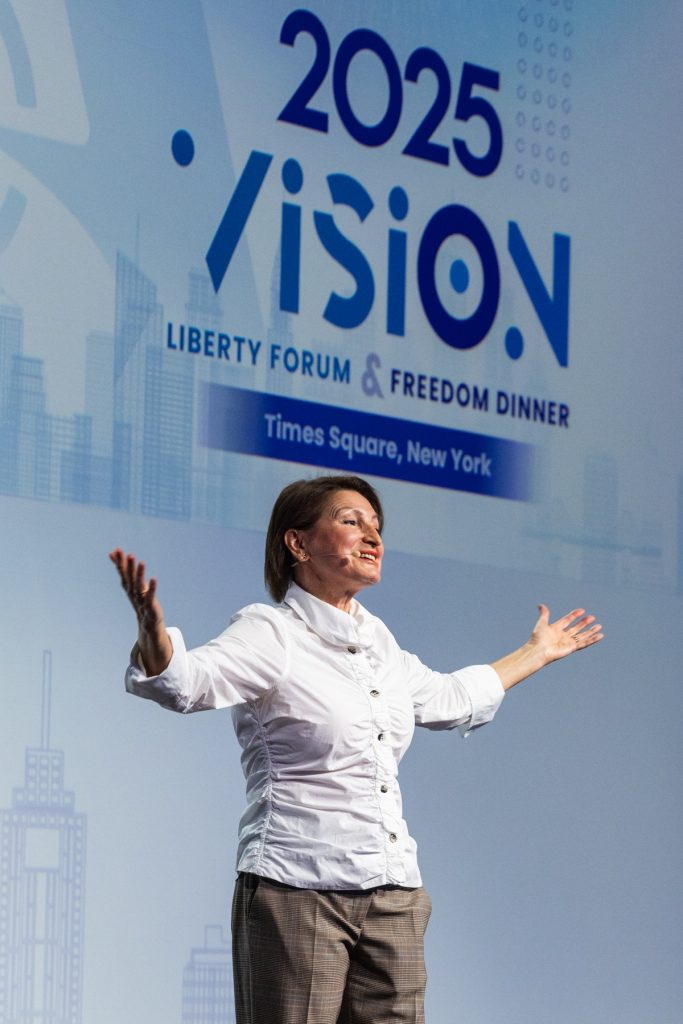
A speech delivered by Elena Leontjeva for Cornerstone Talks at Liberty Forum 2025 in New York City.
The winning free-market argument doesn’t win anymore. We lose to the socialists on emotions and moral ground. When we speak about the market, we speak about institutions, the role of money, and the plus-sum game of exchange. But we rarely speak about people who actually meet in exchange – who are twisted together in their trust and mutual service – to get mutual benefit. The true battlefield is here – in the hearts and souls of people in economic relationship.
In this relationship we pull from both sides, and we are tied together in the same knot. We know that exchange benefits both and creates new value, but it is not intuitive. Unlike toil, people don’t see the sweat when value is born. The same seamless miracle happens when entrepreneurs create value.
But exchange often comes with tension, uneasiness. Sometimes because of unfair action of the other person, but also – from deeper sources, from the human condition itself. Our studies of scarcity reveal that uneasiness, as it is coined by Mises, is our reaction to scarcity. – Scarcity, which is inherent, immanent in everything around us – resources, knowledge, beauty, love, health. We live in the constant tension of incompleteness. Mises calls it uneasiness – people call it pain.

Elena Leontjeva, Cornerstone Talks at Liberty Forum 2025 in New York City (Atlas Network photo)
Economic reciprocity, work, entrepreneurship help us to relieve this uneasiness, to create value, surplus, it satisfies the need that moves us towards exchange. But scarcity cannot be removed – since it is an inherent element and thus – uneasiness will come back. It may change its target – from money to health, from hundreds to thousands, from love to meaning – but it stays around.
As coffee drinkers we want to pay the price we had 5 years ago, while the hands that pick the beans plea for the price of tomorrow. When we use Uber at a rush hour, the price triples to balance demand and supply – good for us: we both benefit, but – we both complain.
Two people in an exchange always feel tension, they come with opposing interests – each wants to buy low and sell high. Their interests are reconciled, and value is increased for both, but their emotions fall behind and disregard this fact. Uneasiness returns – new shapes, the same pain.
Here’s the twist. People confuse this built-in tension of scarcity with the unfairness of the person across from them – or with the immorality of capitalism itself. In ordinary, everyday exchanges, they begin to see markets as a source of pain, unaware of the deeper roots of that pain. Even the best deal never entirely removes our uneasiness – we still want more.
The marginal case to understand this is healthcare. If prices hurt, then in healthcare they hurt mortally – since they touch the limits of being itself – where the beauty of exchange meets the tragic limits of human life. The prices in healthcare reveal the reality of scarcity, and this reality can never be cancelled. But mind you – the same drama is in every purchase — coffee, a new car, or a house.
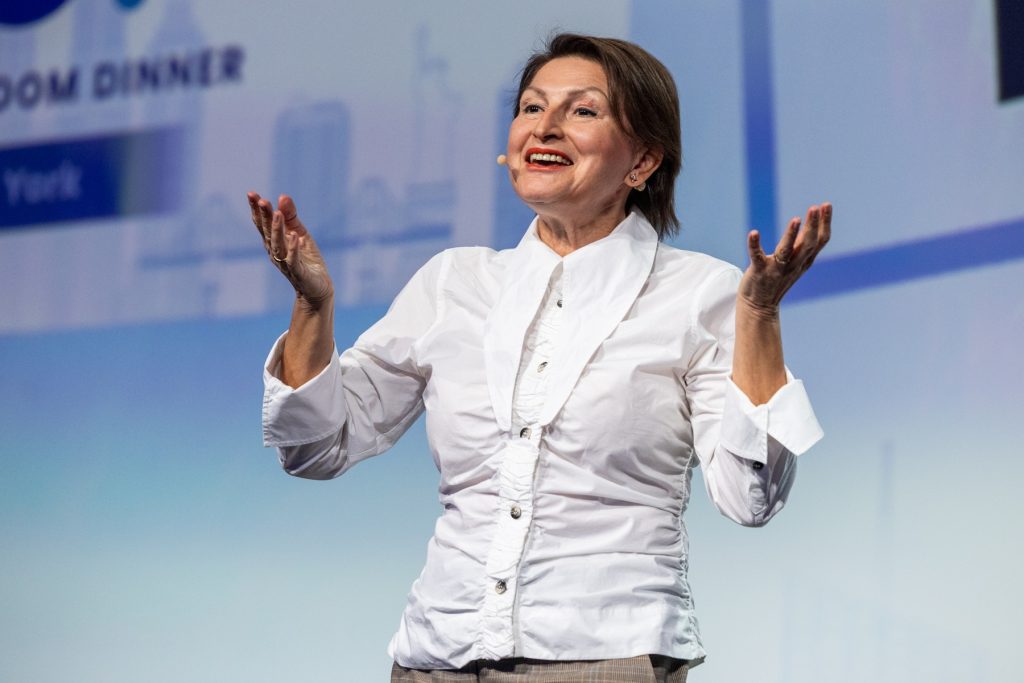
Elena Leontjeva, Cornerstone Talks at Liberty Forum 2025 in New York City (Atlas Network photo)
That’s why people fear and even hate the market – a meeting place with “another one” who is the same as me, who wants to buy low and to sell high.
And here, the Dream Salesman comes in and promises that the state will always set prices in your favor. How absurd! Yet people believe. He promises safety, security, complete control, and regulation over those “bad others”. And people eagerly vote for replacing the other person – and the market itself – with an anonymous, faceless state. They wish to buy everything from the state – cheap, and sell everything to the state – dear. New York, once the capital of capitalism, shows the way.
When Dream Salesman offers everything for free or at “affordable” prices, it means abolishing scarcity. But our study shows: this is as impossible as abolishing time or space. It is the same category! He sells comfort narcotics that relieve the pain for the whole society instantly – and steal freedom later. Different from ecstasy, they do not make reciprocity easier, but simply eliminate it. With time, people lose the capacity to be free and to be together, and even if they desire to get off drugs, we know it is challenging individually; it is even more challenging for society as a whole.
So, where does hope come from? Hayek suggested replacing “oikonomia” (economy) with “katallaxy”. The term comes from the old Greek word meaning ‘exchange,’ admitting the other, and even an enemy, into your circle. And even reconciliation.
Elena Leontjeva, Cornerstone Talks at Liberty Forum 2025 in New York City (Atlas Network photo)
Reconciliation — that’s the word! We must go into this pain and help people reconcile with the scarcity that guides us throughout life and makes us creative, productive, and prosperous; with the other one; and, most importantly, with ourselves and with the market itself. The biggest deception is that people see the reciprocity on the market as the biggest injustice, and as long as they do, they will wish to replace it with the anonymous, faceless state.
That is our challenge and our opportunity: to use neuroscience, psychology – people love them – to explain this pain and show how reciprocity in exchange heals it: we serve each other, we create value, surplus, prosperity, yet scarcity — and uneasiness — will always remain. If people understand that, scarcity may unite, not divide, them.
We as a movement cannot outsource the healing of this pain to the socialists. This is our mission – to go into the hearts of people, into their emotions and even souls, and help them be free and deal with each other, not with the state. At a time when people seek unity, values, and meaning, it is our mission to show the beauty of economic relationships, which is not only economic but, first of all, a relationship. To retain liberty means to be able to coexist with others. And stop social drugs from the dream salesman.