The Lithuanian Free Market Institute (LFMI) marks its 35th anniversary—a milestone for an organization that began its work at the dawn of Lithuania’s independence and has since become one of the most influential incubators of public policy ideas in the region. Founded on November 20, 1990, the Institute laid the groundwork for individuals to live and create in a free market and for the state to act responsibly and efficiently.
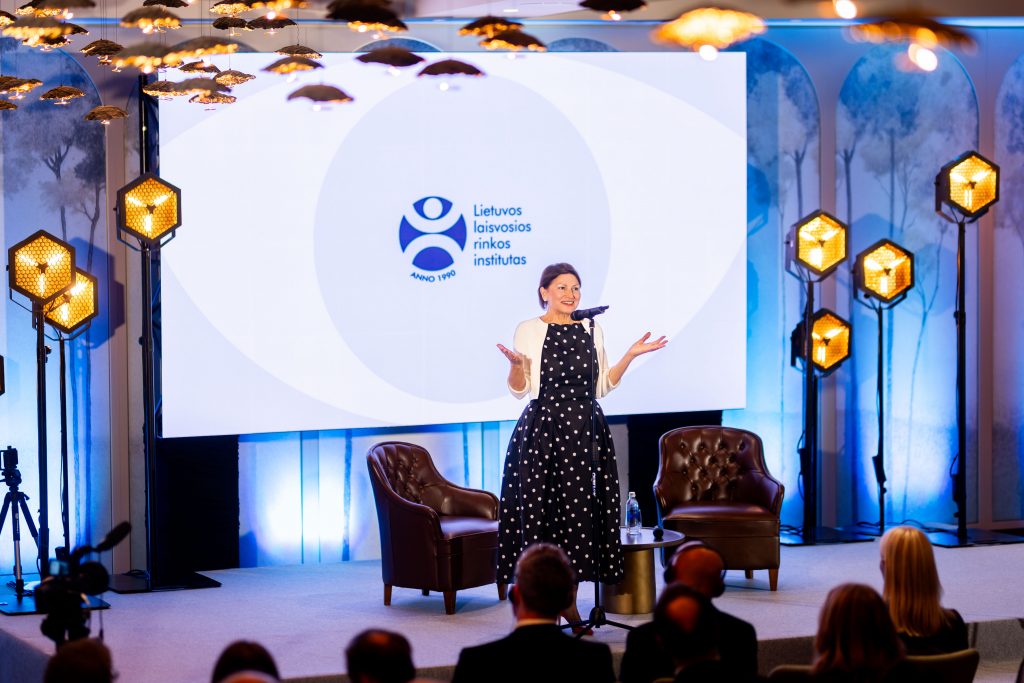
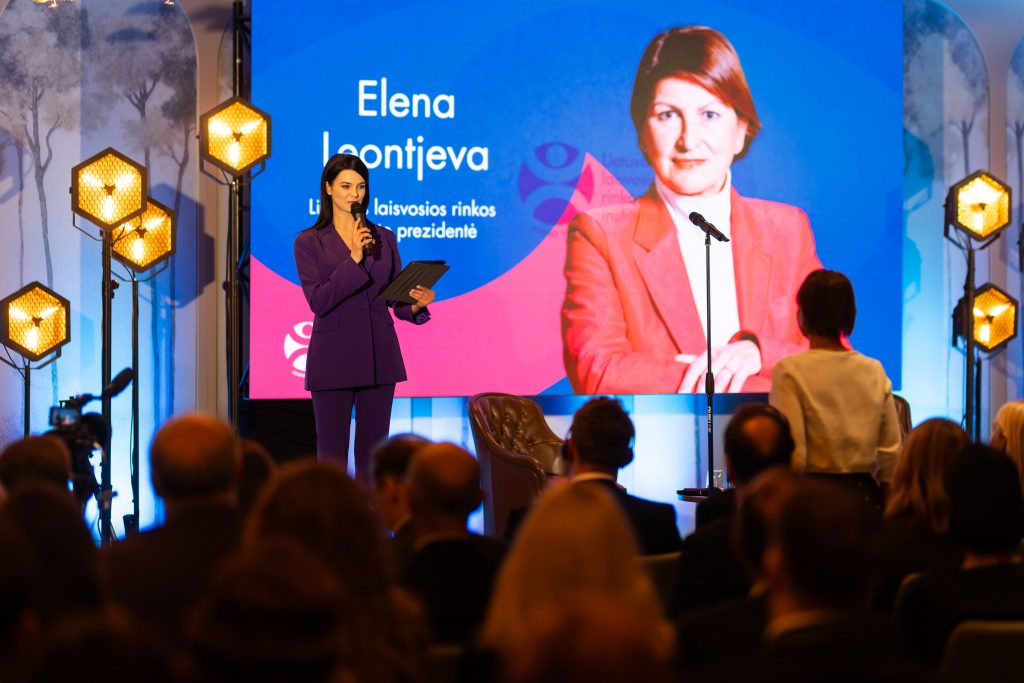
The Institute was established by six economists, led by Kęstutis Glaveckas. Among them is Elena Leontjeva, the current head of LFMI, who recalls passionate debates and shared dreams of a free Lithuania and deliberations on the country’s economic and legal system.
Irmantas Gelūnas photo
“As graduate students of Professor Glaveckas, we were inspired by his vision and courage, and by the analytical center model he brought from his travels in the United States. We decided it was time not just to think in the library about what a free Lithuania would look like—its money, tax system, and property rights protection—but to take action. That’s how the Lithuanian Free Market Institute was born at the dawn of our country’s independence,” Leontjeva recounts.
From its inception, LFMI immersed itself in building the foundations of the nation’s economy, preparing fertile ground for capital formation and investment. The Institute developed guidelines for the banking system, contributed to the creation of the Commodities Exchange, laid the legal groundwork for the securities market, and helped establish the stock exchange and its supervisory body, the Securities Commission. It also spearheaded the introduction of private pension funds. In 1993, LFMI popularized the currency board model, enshrined in the Law on Litas Credibility, which safeguarded the national currency’s stability for 21 years.
Irmantas Gelūnas photo
“Emerging from the Soviet era, we needed to create foundations on which people could legally exercise their freedom, private property, and responsibility—creating, acting, and investing for each other, setting free prices without excessive regulations, and following minimal rules of engagement, while receiving profit as a reflection of society’s evaluation,” Leontjeva explains.
In 1995, LFMI formulated the distributed profit tax model, later implemented in Estonia, Latvia, and partially in Poland. In Lithuania, the zero tax rate on reinvested profits laid the foundation for industrial modernization and export growth.
For many years, a proportional tax system was maintained, and key principles—efficiency, neutrality, proportionality, simplicity, transparency, and stability—were codified in the Tax Administration Act. LFMI also initiated the Lithuanian Municipalities Index, a crucial benchmark for local government reforms. Its insights have significantly influenced labor market, taxation, and pension policy.
“Over more than three decades, we have worked with every elected government w
Irmantas Gelūnas photo
hile remaining independent of political parties. This has allowed us to consistently advance the ideas of individual liberty and limited government,” Leontjeva notes as the cornerstone of the Institute’s success.
LFMI introduced “Taxpayer Respect Day,” commemorated annually on May 11, and in 2014 launched the innovative online calculator mokumokescius.lt, allowing individuals to see exactly how much tax they pay and how those funds are allocated in the state budget.
“We aim for people to act freely and unrestrainedly—but that means responsibly and ethically. This requires institutional foundations, knowledge, and an understanding of ethics. Only in such a society is it possible to create and trust others,” says Leontjeva.
Irmantas Gelūnas photo
Internationally, LFMI is recognized as one of the strongest public policy centers. According to the Global Go To Think Tank Index, the Institute ranks among the top analytic centers in Central and Eastern Europe and the top 1% worldwide.
The Institute has won the prestigious Templeton Freedom Award three times, and in 2022, LFMI president Elena Leontjeva received the Sir Antony Fisher Life Achievement Award for advancing ideas of freedom and contributing to Lithuania.
LFMI educates not only the public and policymakers but increasingly focuses on nurturing the next generation, teaching foundational economic principles and their connection to freedom and morality. The LFMI textbook Economics in 31 Hours won The London Book Fair Excellence Award. Translated into five languages, it has been adapted for Ukraine, Georgia, Slovakia, Greece, and Uganda. Its digital counterpart, Citizen in 31 Hours, won the 2023 European Innovative Teaching Award in Brussels.
Irmantas Gelūnas photo
The Institute also initiated the National Economics Exam, which evolved into the National Economics Quiz, attracting tens of thousands of participants annually. In 2024, responding to educators’ needs, LFMI launched the Prospera Academy—a center where economics intersects with ethics and civic responsibility, fostering courage, economic maturity, and accountability.
“Teachers especially value that we help young people understand that being free and responsible is natural, honorable, and trendy, and that prosperity comes from productive effort, not redistribution. Students enjoy discovering citizenship as a personal connection to familiar phenomena,” says LFMI Vice President Aneta Vainė.
Since 2015, LFMI has pursued a unique focus on interdisciplinary studies of scarcity. These studies reveal that limitation and incompleteness are intrinsic to existence, enabling creativity and empowering individuals to be creators. Drawing on this research, LFMI produced the 2019 documentary Sublime Thirst, bringing the concept of scarcity into public discourse and political thinking, encouraging a reimagining of human freedom, responsibility, and the role of government.
Irmantas Gelūnas photo
As it celebrates 35 years, the Lithuanian Free Market Institute remains a school of statecraft and action—a place where ideas of freedom translate into concrete policy recommendations, educational initiatives, and a bridge to the future.
“Freedom is not a given—it is a human quality that requires constant effort, awareness, and mutual trust. Our mission is to continue building institutional foundations so that Lithuania remains a place where it is good to live, create, trust, and take responsibility,” says LFMI President Elena Leontjeva.